
Written on October 23, 2026.
When you call a business, a recorded voice often answers first. Sometimes it asks you to press 1 for sales or 2 for support. Other times it asks you to just say what you need, like you are talking to a real person. These are two different kinds of phone helpers.
The first kind is called IVR, which stands for Interactive Voice Response. The second kind is called IVA, which stands for Intelligent Virtual Assistant. Both of them greet callers and help them get where they need to go. But they work in very different ways.
In this article, we will look at IVR vs. IVA in simple words and help you choose the best fit for your business.
An IVR is a phone menu that uses recordings and keypad buttons. When someone calls, the system plays a greeting and lists a few choices. The caller presses a number on their phone, and the system sends the call to the right team. Some IVR menus can also understand simple spoken words like "billing" or "yes."
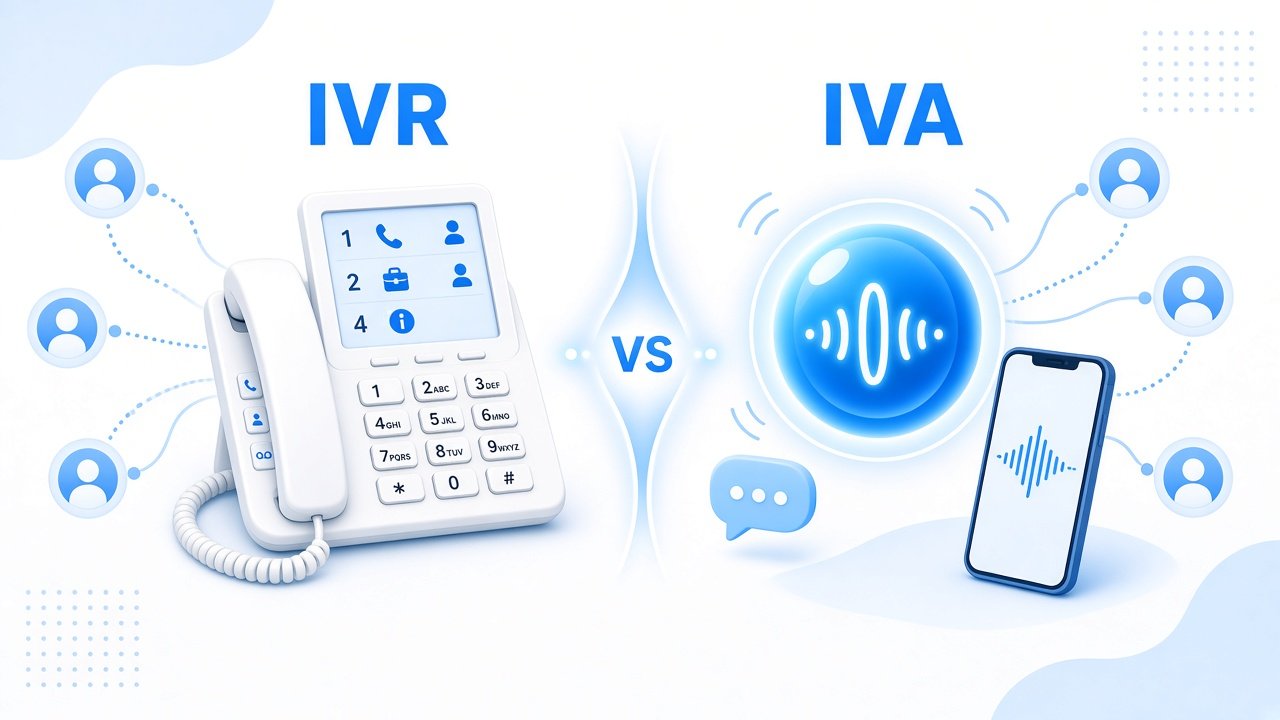
IVR has been around for a long time, and it is still very popular. It is easy to set up, it does not cost much, and it does the same job the same way every time. For a business with only a few clear choices, an IVR can be all it needs. You can learn more in our guide on how interactive voice response works.
The downside is that an IVR can only follow the paths someone built for it. If a caller's question does not fit any of the choices, they may get stuck pressing buttons or end up waiting for a person anyway.
An IVA is a smarter kind of phone helper. It uses artificial intelligence, often called AI, to listen to what the caller says in normal words. Instead of pressing 3 for billing, a caller can say, "I have a question about my bill," and the IVA understands what they mean.
An IVA can also do more than just pass calls along. It can answer common questions, check on an order, book an appointment, or help reset a password without a worker joining the call.
The tradeoff is that an IVA usually takes more work to set up and can cost more than a simple IVR. Tools like Retell AI voice agents connected to BulkVS show how businesses are starting to build these smarter helpers on top of regular phone lines.
The easiest way to think about IVR vs. IVA is buttons versus conversation. An IVR asks the caller to pick from a list. An IVA lets the caller talk freely and figures out what they need.
Another big difference is how much each one can handle alone. An IVR mostly points callers to the right place, while an IVA can often solve simple problems on its own. That can mean shorter waits and fewer calls for workers, especially when it is paired with good call queuing for busy lines.
Cost and setup are different too. An IVR is cheaper and faster to launch. An IVA takes more planning, but it can give callers a more natural experience. Both still need a strong phone connection underneath, because even the smartest system cannot help if the call sounds choppy or drops.
When thinking about IVR vs. IVA, start by looking at your callers. If most people call for just a few simple reasons, like sales, support, or store hours, an IVR may be the perfect choice. A basic automated answering service can cover a lot of these needs.
If your callers ask many different questions, or if your team spends lots of time answering the same things again and again, an IVA might be worth it.
Some businesses use both. They start with a short IVR menu and add an IVA for certain tasks, like checking order status. This mix lets a company grow step by step instead of changing everything at once.
No matter which one you pick, keep it friendly. Use short greetings, clear words, and always give callers a way to reach a real person.
Whether you choose an IVR, an IVA, or a mix of both, your phone system needs reliable voice service behind it. Bulk Solutions offers SIP trunking and phone numbers that work with both kinds of tools, and we value Quality and Reliability above everything else. You can check our current pricing page, or read more about inbound call handling and computer telephony integration.


